Saturday, July 12, 2008

Where it begins

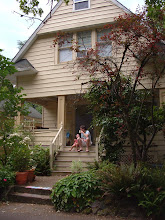
In response to folks who've asked, "How's the thesis coming along?" here's sneak peek at part of the intro, not-so-sneakily disguised as a blog post and supplemented with photos from the kitchen renovation mentioned in the first graf:

One summer morning in 2007, my two-and-a-half-year-old daughter padded downstairs to find the refrigerator in the dining room. The prep tables that had once served as extra kitchen counter space were now also in the tiny room, along with the cobalt blue microwave and the stainless steel rack that had once held dishes in the nook. SB didn't bat an eyelash. As she climbed into a chair at the dining room table, I explained that we were starting the kitchen remodel that day and she'd be going over to a neighbor's house for a few hours so her dad and I could tear the lathe and plaster off the walls. Still completely unfazed, she nodded her head agreeably and asked for a strawberry yogurt.

Although I later wondered what it must be like to grow up in a state of constant upheaval--piles of debris and tools spread throughout the house as common as piles of stuffed animals and Crayola markers, the gritty film of sheetrock dust on every flat surface, the sharp smell of varnish and paint in the air--at the time, it was simply another day in our family's life. Even in utero, SB must have heard Alex and I arguing about where to put the skylights, what color to paint the bedroom, or whether to use oak or bamboo flooring upstairs. Some kids wake up to high-rise views of the city or the smell of grass and cows in the country: SB spent her first three years enveloped in the sights, sounds, and smells of a house in progress.

My husband and I aren't flippers or remodelers: we both have full-time jobs in fields that have nothing to do with real estate or houses. Instead, we're middle-class homeowners who bought a small house in a hot real estate market and then spent the next several years transforming it into a wood-and-mortar version of who we are. In other words, we're a lot like the other young upwardly mobile American couples you might know or see at Home Depot early on Saturday mornings or read about in Sunset and Dwell magazines.

If we were just a generation older, we might have been called yuppies, but we're more akin to what David Brooks, in his 2000 book, dubbed "bourgeois bohemians" or "bobos": mid-twentieth century anti-establishment liberals who broke through the traditional stranglehold of Protestant elites at the country’s best schools and worked their way up various professional ladders to suddenly find themselves firmly on the upper and upper-middle class rungs of American society. Brooks says that because of this history, Bobos are “an elite that has been raised to oppose elites,” and, therefore, a conflicted lot—a socially enlightened, educated class that feels anxiety and guilt about their wealth and participation in consumer culture.

Brooks says that in response to this guilt, Bobos have devised a set of codes to both justify and regulate their participation in capitalism, “encouraging some kinds of spending, which are deemed virtuous, and discouraging others that seem vulgar or elitist.” Virtuous spending might include buying old or handmade things that show craftsmanship and have “soul,” or supporting local, small businesses over large, national chains.

Although we’re perhaps on the tail end of the Bobo generation, Alex and I and most of our peers not only have the college diplomas and white-collar paychecks, but also guilt and anxiety about consumerism. In broad, general strokes, we are a group of people who strive to be hands-on, conscientious, political citizens who buy local goods, eat seasonal produce, and make things with our hands. Of course, this runs a wide gamut: Some people don’t own cars, grow much of their own food, and buy products from within one hundred miles of their homes. Others invest in green building and remodeling supplies and drive Priuses. Others buy mostly organic produce and eggs, use low-VOC paints, and grow native plants. But regardless of the various permutations, for most of us, our homes are both our laboratories where we experiment with materials and ideas, and our canvases on which we communicate who we are and what value.

It makes a lot of sense that Bobos use houses in political ways, because doing so justifies what is, for most middle-class homeowners, a huge expenditure and also the straightest path to wealth—less risky than the stock market and more profitable than a savings account. By renovating an old house with “soul,” building a green house on an infill lot close to public transportation, or pulling up lawn to plant vegetables, we can rationalize home ownership as virtuous spending. And on a more spiritual level, a house can be a life’s work, akin to a novel or painting or symphony. It can be justified as an aesthetic endeavor that fulfills deeper, undeniable human needs.

Wednesday, July 9, 2008

Hump Day: Messy but Inspiring

This is what our coffee table looks like by Wednesday. (Actually, this is what it would look like any day of the week if one of you dropped by unannounced. If you want a cleaner house, we need at least a few hours notice.)

The entire living room looks much worse: There are a couple of days-old half-full glasses of water on each side table (at least they're on coasters). And the mantel is a temporary resting place for an unopened box of light bulbs, a sorrowful Christmas cactus, an IKEA lamp that still hasn't found a permanent place to live in our house, the receiving end of a baby monitor, a ball of multi-colored sock yarn saved from the jaws of our cat, a bright yellow 100-foot measuring tape that weighs about five pounds, and a lovely set of Chinese bud vases some dear friends gave us as a house-warming gift (this last item really does want to live on the mantel, but can't really feel at home what with the overcrowded conditions).

Think of our coffee table as a symbol of the rest of our house: messy but inspiring.

For instance, from that pile emerged a great essay from the June 30 issue of the New Yorker: "Altered State" by Andrea Lee. I'm still thinking a lot about the ideas of belonging and patriotism I wrote about in my July 5 posting (which some of you talked to me about offline--thanks for the feedback!). So perhaps I'm just ripe for Lee's thoughts about her home state of Pennsylvania--about which she writes, "I'm not sure I love it, but it's mine."--and her sense of always feeling like a foreigner. But what most struck me, aside from her amazing skill as a writer, was the deep thought she's put into her past, not simply narrating it, but contextualizing it and using it to explore how she ended up where she is today: an African American novelist who married an Italian and is now raising her family outside of Turin:

When describing another American family (oddly enough, also from Pennsylvania) that lives nearby, she writes, "[They form] a traveling homeland still magically connected to that landlocked region, where there are school friends, cousins, acres that bear their name."

When remembering how she was the only African American child at a summer camp, she describes trying to fit in: "I try hard, out of an animal sense of self-preservation, but also because I've always imagined winning the hearts of hateful people."

When pondering why one brother stayed in Philadelphia while she and her other brother live an ocean or continent away, she posits that the brother who stayed was her mother's favorite and writes, "And who can say whether being your mother's great love doesn't trigger a lifelong passion for your home, your city, your state?"

And near the end, when reminiscing about her home state with an Italian movie director, she realizes that perhaps he is "Someone who can stare, as he does, across land and sea toward a shimmering mirage of America."

Maybe it's because of the Fourth of July that I really took a shine to this piece. Or maybe it's because I've spent so much of my life feeling like an outsider. And it's hard to not to see some of James Baldwin (a hero of mine--and hers, I'm willing to bet) in Lee's work, which makes it especially compelling. But perhaps it's because there's an incredible amount of self-reflection going on right now--people exploring how they live and why, through books and lifestyle changes and blogs like this one--that it's inspiring to see it done right and well, artfully and eloquently, in an essay like this one.

Monday, July 7, 2008

Mommy Crush #176

Forty-one-year-old mother qualifies for her fifth Olympics and, in the process, breaks the U.S. record in the 50-meter freestyle? Yes, please.

Though this is reason enough to cheer swimmer Dara Torres on next month, if you haven't already read the New York Times magazine profile of her, you must, at the very least, check out the photo of her in a bikini. ("A Swimmer of a Certain Age," in the June 29, 2008 issue) She's got a bod like no mom I've ever seen (and I've seen some tight Portland moms rollerblading, biking, and running their way through town).

I was so impressed that I showed the photo to my husband, who simply said, "Wow." SB asked to see it, too, and, looking concerned, asked, "What's wrong with her tummy? Why does it look like that?" Of course, she's never seen a six-pack before. (Neither have I on my body. Ever.)

Turns out, Torres drops something like $100K on a staff of folks (including a nanny) who help her make her body what it is: a lean, mean, racing machine. This staff includes two "stretchers" who watch for tensions and asymmetries in her body as she's training and then "mash"--contort, flex, massage, and stretch--her muscles a couple of hours a day, three times a week. The result is a body that earns admiring comments like, "Look at the way her scapula is traveling!" (If anyone complimented my scapula, I'd be set up with enough self-esteem to last for days.)

With cyclists being kicked out of the Tour and baseball player testifying before congressional committees, all eyes have been on Torres because she's been too good for too long. But she volunteered for a pilot program to test broadly for signs of doping because she's got nothing to hide. Girl's not on drugs: she's got bank.

Sure, I might not spend any extra cash I have trying to get another couple of medals for my trophy room, and don't ask me to speculate about her home life. But, after battling bulimia during college, landing this side of two divorces, and struggling with years of infertility, Torres now seems to have accepted exactly who she is: an extremely competitive person who's not letting age or gender get in the way of winning. It's hard not to admire that.

Sunday, July 6, 2008

Summer Sunday snapshot


Here is what this moment in time looks like in fruit: the last of the season's strawberries, the influx of raspberries, the first hints of cherries and figs. Though the canning pot waits ominously in the background, this day is too lazy and sprawling for cooking fruit, which seems like a sensible but, today, too foreward-looking a thing to do. Instead, we're living in the moment and eating the fruit fresh and naked--save for an occasional smear of goat cheese or dollop of chocolate--as we pass through the kitchen on our Sunday meanderings through the house. 

Guests stopped in throughout the morning to enjoy this day and these seasonal gifts with us, bringing gifts of their own: Chris brought pastry and watched stage two of the Tour with Alex and SB. Gaylen brought advice about gardening, while her lovely girls made fairy dust and had tickle contests with SB. I want the rest of the day to be as easy as this: catching up on last week's Times, hula hoops and basketballs in the back yard, M. Ward on the iPod, an effortless stroll around the block, a salad for dinner with leftover soup, SB's made-up songs drifting throughout the house until bedtime.

Happy lazy Sunday, everyone.

Saturday, July 5, 2008

$12 and I'm back in the game!

Okay, not only am I a fairly lazy person, I can also be incredibly indecisive. The gears in my Raleigh have been randomly and suddenly slipping for, I don't know, a year. But since we moved closer to downtown, I've started using it to commute to and from work. Because I have a thirty-block gradual uphill ride home, slipping gears have become an issue (as in, I don't want to ride home anymore).

So for weeks, I've woken up every morning muttering, "I've got to take my bike in," but couldn't decide where to take it: the shop that I don't like as much but that's only blocks from my office, or one of the three within a couple of miles from my house that I'd have to visit during precious weekend time. I finally got off my butt and made a decision, and $12 later, I have control of my gears. I took the bike out for a spin this evening and returned home giddy with power. This week, Salmon Street will be mine!

United States, Oregon, Portland

Ah, Fourth of July--yet another opportunity to clumsily explain an abstract concept to a preschooler. Answering "How do they make fireworks?" was hard enough. SB tossed that one to me a couple of days ago and I deflected it to Alex, who mumbled, "It's made out of gunpowder." You can imagine how that started us on a road we didn't want to be on, but I think she was satisfied by the time we were able to compare a firecracker to a candle, but one that exploded, because candles, though scary, are at least real and understandable.

The harder question came when she overheard an NPR segment of Americans talking about the Fourth and what patriotism meant to them.

"Patriotism is when you love your country, when you feel loyal to it and all the people who live in it," I said. Realizing I'd slipped and used the word "loyalty," I braced for the follow-up question.

But instead she asked, "What's a country?"

"You know, America."

"Oh yeah," she said, suddenly confident. "We live in the United States, Oregon, Portland."

Though I felt the urge to try to better explain “patriotism” to her, dissatisfied that the slim weight of my words seemed incredibly simplistic, I just said, "Right.”

But later, it occurred to me that her reversed order of place, from largest to smallest, from nation to city, was actually a pretty accurate way to describe what seems to be happening in our corner of the world today: Though patriotism usually refers to love of country, I've been feeling patriotic to local communities and trying to support these smaller economies rather than the larger ones that, we're told, keep our country afloat (e.g., the churches of Gap and Target, of cars and McMansions).

To me, local patriotism means cutting down on gasoline consumption and instead riding to work on my bike over the Hawthorne Bridge and along the waterfront with a long line of other cyclists. Or resisting the allure of Trader Joe's (wonderful as their foods are) and joining bulk food buying groups or hanging out at the Eastbank Farmer's Market on Thursday evenings with friends old and new, picking up beautiful locally grown fruits and vegetables, and munching on delicious, handmade food (TodBott's Triangles and Sol Pops are two favorites). Or, after a long day at work, resisting the urge to hunker down in front of the TV and its barrage of advertising, and getting together with other families for picnics and play at Portland Parks concerts instead.

Because when you get down to it, the biggest reward of patriotism is the sense of belonging that it brings. And belonging can be hard to come by in a country of more than 300 million people. It's much easier to feel the love in these smaller communities that are clustered around shared ideas and interests, and, most important, that brush up against other small communities from which we can pick up new ideas, passions, and ways of living. For example, though I’m more into bikes and local foods than I am into DIY crafts and raising chickens, I love being able to brush shoulders with crafters and chicken folks on the internet, through media, and on my travels through town.

Sure, this is all sickeningly romantic because of the season: we Oregonians are pretty giddy and lovey-dovey by July after being locked indoors during several months of rain. Come winter, I'll probably be in my car, at TJoe's, and watching The Office like everyone else. But patriotism is a romantic notion, anyway, because it's not merely the love of a place and its people: it's the love of an idea. What we're really celebrating on the Fourth is not necessarily the birth of a country, but really the anniversary of some ideas that we all still think are pretty great: the rights to life, liberty, and the pursuit of happiness. And those ideas trickle down to show up as things that matter to us in our daily lives, in our relationships with other people and in the choices we make with our money.

Without a doubt, being a mother has made me a better citizen: not only have I become more loyal to the ideas of America, but also I've become more involved with my communities and more demanding of myself. And this has translated into a daily juggle with the tensions of loyalty and criticism, which, when you really think about it, is the balance that prevents us from falling into complacency and keeps us accountable to one another.

So when my daughter asks me hard questions like “What is patriotism?” instead of feeling dissatisfied by my inability to explain, I should, perhaps say nothing and just hand her a raspberry or take her to play with a good friend or point out the bikes that flood our city’s streets. There's lots of time ahead for words.

Wednesday, July 2, 2008

Home-living over books and snack?

Where does my daughter get her love of domestic chores? Here she is, voluntarily sweeping the porch with my BFF's adorable son.

From a very young age, SB has always been a regular in the home living area of her daycare, which is decked out with a play kitchen, dining room, couch, dress-up clothes, and baby dolls. During free play time, home living is a "choice"; there are lots of other "choices," including doing art, playing at the sensory table, reading in the library, and having a snack. But her teacher tells me that, 90 percent of the time, SB makes a beeline for home living to cook, clean, and take care of babies.

"She picks that over snack and books?" I asked, incredulous, wondering if this small person has been paying attention at all to how things go down at our house.

I mean, I rarely choose to hang out in the home-living section of our house. Alex likes to cook meals, even on weeknights; I could subsist on take-out and finger foods. He does a lot of the cleaning, too; I haven't touched the toilet or cat litter box in years (still coasting on the whole "pregnant women shouldn't clean the cat box for fear of contracting toxoplasmosis" rule). I specialize in fun domestic chores like making elaborate desserts and storing bulk foods in attractive containers and scheduling social activities.

In my observations of my friends' domestic lives, this arrangement seems fairly common--not at all as unusual as it might have been a generation or two ago. And it turns out that this kind of equity in domestic chores will at least keep us in the business of being a country: Did anyone catch the New York Times Magazine cover story this week, "No Babies?" It's fascinating look at how birth rates are dropping so drastically that some European countries are facing population declines and demographic shifts that are, according to one professor, "pathological." Some sociologists think one of the causes for this decline is the growing tension between traditional and modern roles of women: studies show that women who do the majority of the housework and child care have fewer children than those who have partners who "share the load."

But population replacement rates aside, I assumed this gender role shake up would somehow be visible in my daughter, evident in a kind of genderlessness--you know, playing with trains in a princess dress, bouncing a ball while rocking a baby to sleep. But maybe it's only been confusing to her? When she was about two, she commented that "Daddies go to the office and mommies stay home," and I corrected her by naming off all the working moms (myself included) she knew. But the reality/perception thing baffled her for months.

She's getting older, though, and figuring it out: A couple of months ago, she told me she was choosing art because she didn't like to clean up the home-living section after she was done playing. And a couple of weeks ago, she remarked, "Dada's a good cooker and cleaner. He's the boss of the house." Then she hurriedly added, "But Mama's the boss."

"Sure," I said, my defensiveness immediately quelled by the formula of Mama=omnipotent, Dada=middle management.

Then she wandered off to cook in her play kitchen, reciting a list of things she was going to pick up at the grocery store--after she was done with her "deadline." Aha. She's been watching us after all.