Is it normal to feel so bereft after being practically done with the project that has consumed every free minute of my life for several months and that has haunted me (the guilt, mostly) for years? I feel out of sorts. I keep thinking of things like public space, private space, house as a symbol of (fill in the blank). That's not just a "green home"--that's a political stand, a sign of the times, a vote with dollars. But maybe it's just a cool house with a living wall and roof, graywater processing system, and solar panels, all backed by someone with more time and money than he/she knows what to do with. Perhaps some things are not more than the sum of their parts.
We have fun family or mama/SB things planned all weekend. I have a stack of magazines, all glossy and undogeared, waiting on the coffee table and nightstand. I even bought two brand-spanking-new books, which I never do, cheapskate that I am (Plenty and House at Sugar Beach). Yet, I'm fighting the urge to sit at my computer or scribble notes on scraps of paper. While eating lunch with SB, I got up and wrote the following on a Working Assets pad of paper I found in the debris of my desk: "Public v. Private lives. Milk on porch. Internet. Green parenting. Risk private for public? Holloran. Losing data and identity theft. Embrace public." Good grief, woman. Let it go for a couple of weeks.
But I'm Type A--can't sit still, have to stay busy. Which is a kind of sickness. Or is it that cliche about scratching at a long-ago amputated limb? One day, if I'm lucky, I'll forget about it. But that day is not today.
When we were out celebrating Alex's birthday the other night, he asked, "So, what are you going to do now that your thesis is mostly done?" I was supposed to say, "I'm going to Disneyland!" but instead my shoulders seized up and I felt a flush of panic flood my body. What am I going to do with all my newfound time?
My acupuncturist says to maybe just let the rest of my life, the stuff that's been crammed into the tight corners of my days, stretch out a bit. Don't fill yourself up again, she gently warned me, as she stuck me with about thirty needles meant to beat back an encroaching cold and get rid of weeks of stress. But she's not like me. She's a mellow, relaxed person. Just being in the same room as her makes me sleepy. I might be lazy, but I'm rarely ever relaxed.
The thing is, I remember a time before full-time work and family and trying to live a greener life and writing in the spare minutes of a day and hanging out with friends. I had less to do, I was more relaxed, but some days, I couldn't even get out of bed. There was nothing to yank me out of own head and into the world. I cried a lot and felt sorry for myself. That was a crappy time of thinking too much and doing too little.
The swirl of sound and color and motion—of SB and her friends running through the house while unwinding a ball of yarn, of jam burning on the stove, of hooting and moaning at the Daily Show, of Twittering about Project Runway, of newspapers and magazines slipping off of every flat surface in the house, of weekends so full that they feel like weekdays—that mess of parts equals the sum total of my life. The energy of this crazy book project can't just disappear, so where will it go? I'm not worried: something else equally sparkly and distracting and addicting will come along. And honestly, I can hardly wait.
Showing posts with label thesis. Show all posts
Showing posts with label thesis. Show all posts
Friday, September 26, 2008


Wednesday, September 24, 2008
Whew!
It's done! 113 pages. Finished a draft on Sunday night at 10:30 and turned it in to my advisor on Monday afternoon. Whew.
Next up: a week of revisions in mid-October then I give copies to my committee. A ten-page written exam later (WTF?) and I defend in late October/early November. If all goes well, I'll be a master by December!
On Sunday, the last day of thesis writing, as SB was heading out with Alex to the Children's Museum to meet some friends, I heard her say, "I miss Mama." Almost stopped working to run out and hug her, but realized that I just needed to keep writing so that I could join my family in the real world again.
Next up: a week of revisions in mid-October then I give copies to my committee. A ten-page written exam later (WTF?) and I defend in late October/early November. If all goes well, I'll be a master by December!
On Sunday, the last day of thesis writing, as SB was heading out with Alex to the Children's Museum to meet some friends, I heard her say, "I miss Mama." Almost stopped working to run out and hug her, but realized that I just needed to keep writing so that I could join my family in the real world again.
Saturday, August 30, 2008
The home laboratory
I'm busy this weekend getting through the last of my taped interviews for the book, so here's another excerpt from the project, this one from chapter two, "The Home Laboratory":
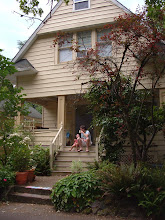
 Within two weeks of moving into the house on NE 70th, Alex cut a hole in the wall between the living room and a bedroom and put in a set of French doors, which nearly doubled our living space. Because of the noise and the dust, he waited until I was out one evening before breaking through the lath and plaster, and I arrived home later that night to a cloud of dust, the sight of wires dangling from open walls, and a new life of plastic tarps and face masks.
The bungalow wasn’t technically a fixer. It was absolutely habitable, according to the bank appraiser and to us. We slept in the roughly finished attic for years before completely remodeling it, though the ceiling was lined with three different sizes of acoustic tiles and the subfloors threw off brown latex paint chips that clung to the soles of our bare feet. The rest of the house was fine: any other homeowners might have merely repainted the main living rooms and perhaps had the kitchen cabinets refaced, and then called it good.
But for Alex and me, the house was a perfect laboratory, a place to try out new ideas and designs—What would the walls look like in bright orange? What if we carved out space for a bathroom upstairs and installed skylights that let eastern light in? What if we added an exterior door at the back of the house where the nook was? Perhaps it’s easier to feel inspired by home remodeling projects that address creative longings rather than necessities.
When we first looked at the bungalow, the living room and adjoining dining room seemed impossibly small. Brad chalked it up to the owners’ clutter and over-large furnishings, but even several weeks later, when we walked through the empty place for the first time after getting the keys, those front rooms felt stingy and tight. In a typical sellers’ market kind of buyers’ remorse, that first walk through was incredibly bittersweet: It was later in the evening and the previous owners had left the place dusty and dank, the smell of basement permeated all the rooms of the main floor. We fumbled in doorways, searching for light switches, but once lit, the deserted rooms seemed too yellow and faded in the glow of cheap fixtures. The house, which had loomed large in memories garnered from only two brief visits, was disappointing: a smaller, sadder replica of itself, shrunken and deflated.
The main problem was the floor plan—there was no drama, no surprise. We knew that would have to be the first thing to change. Many of these modest, 1920s bungalows were designed the same way, so that when you’ve seen one, the others all give a sense of deja vu: a front door that opened directly into the living room, which was divided from the dining room by half walls or a broad archway, with a kitchen through a single door beyond. Also included on the first levels of these small homes were two bedrooms, a bathroom, and a steep set of stairs that led to an attic, which by the end of the twentieth century, more often than not, had been finished to provide more space. In her book Bungalow Nation, Diane Maddex notes that “a bungalow’s universal characteristic is that it is no bigger than it needs to be.”
Increasingly, middle-class Americans are discovering that though they have character and soul, old houses like bungalows don’t always accommodate modern lifestyles. My friends and I chide each other for complaining about how our houses seem barely large enough for our small families of three or four, because we know that much larger families were raised in them, with three or four children to a bedroom. Although the size of the American family has shrunk decade by decade, our need for privacy has inversely grown—and quiet space is a tough thing to find in traditional two-bedroom bungalows. Not to mention that the lifestyles of some modern families seem to require whole rooms for activities such as watching TV, working on a computer, washing clothes, and exercising.
But even for homeowners who creatively use nooks and corners of other larger rooms, including the less-finished spaces of attic and basement, it’s undeniable that our activities today come with a lot of stuff: closets crammed with jackets for every season and equipment for every recreational activity, kitchens full of gadgets and small appliances, basements and garages piled high with unused furniture and boxes of mementos. No longer do our activities swirl mainly within the walls of our homes—sewing, cooking, canning, cleaning, reading to one another, working together in support of the domestic life of the family. As Stewart Brand writes in How Buildings Learn, “Economically, the home has been completely transformed in a hundred years from a place of production to a place of consumption.”
Marjorie Garber notes that it’s easy to be judgmental about materialism and consumption in the modern American home, and pass them off as displays of status. “But take away the sense of invective here,” she writes, “and you will be left with a different kind of ‘reality’: things, commodities, objects, consumable goods, are not only possessions but a kind of language. They are, like it or not, the way we communicate with each other, with ourselves, and with the world.” Though it may be of little comfort when feeling jealous of a friend’s closets or complaining about the lack of a playroom in 1,400-square-foot bungalows, at some level, it makes sense that we want our homes to not only meet our daily needs, but also tell the story of who we are.
Rather than building a new house that does all of this in the suburbs, many Portlanders are turning to major renovations of traditional houses in the urban core. With their sense of history and soul, bungalows can ease the anxious, guilty minds of middle-class intellectuals who feel that through renovation, they can become a part of a house’s history, while actively shaping its future.
Friday, August 22, 2008
Things you'd have done this week if you lived here
 1. Jacked up your house: You notice that the front half of your house is sagging, so you tear the walls apart to find out why (no header, see "House archaeology" post), talk your wife into letting you jack the house up yourself, then, jack the house up yourself. You have to build a temporary wall to do this, and then cut the old studs so that the house will actually rise. During the week that you're raising the jacks, quarter-inch by quarter-inch, the continental plates of your house will drift back together into Pangaea: the door to your daughter's room will actually close rather than have a two-inch gap in the frame, and she'll be able to open her jammed closet door herself rather than calling you to do it for her every time she wants her dress-up clothes.
  Throughout the whole process, your wife will have a semi-permanent worry furrow on her forehead and may need constant reassurance that you know what you're doing, not merely think you know what you're doing. Though you've been together a long time and have done many difficult tasks simply by reading books, getting advice from friends, and tapping into your bottomless well of confidence, you should just smile and tell her things will be okay. And when you take a day off in the middle of the week to build the new wall, and then run into a moment where the house almost falls down because the temporary wall slips and the old wall is no longer there to hold it, and you have to grab a two-by-four to prop the house up while you run out to the garage and cut more two-by-fours to hold the rest of the house up--you should skip that part when she asks you, "How'd things go today?" Just show her the finished product, accept her congratulations and thanks, and sleep the sleep of angels.
 2. Get dragged all over the tricounty area in search of even more fruit: Your parents call you a fruit bat because some summer mornings you want blueberries, peaches, watermelon, and apricots with your yogurt. But by mid-August, even you are tiring of fruit. It's peach season, and your mom's got some unexplainable attraction to stone fruits, so you have to get dragged away from your art table and your back yard kiddie pool to drive hella far east or west to find farmstands and u-pick orchards. It's hot in the car and the air conditioner doesn't really reach you in the back seat, and your carseat feels too small and cramped--Will they just get you a booster seat already? Maybe one with a cup holder like your friend Z. has.
 When your mom's friend calls one night and says, "The Veteran peaches are here!" you just know tomorrow is shot. And sure enough, you're on the road at 8:30 a.m. on a stay-home day. You're in the back seat with a grown-up you've just met, so now you've got to make small talk, which is fine, but it's a long drive and your mom and her friend in the front seat are talking about boring things like anti-consumerism and urban homesteading, so you talk to the nice grown up next to you about your favorite color and point out letters you know on the billboards outside.
The orchard is just another orchard--seen one, seen them all. You make your mom pull you in the wagon and then pick a few peaches that are growing at branches at your height, sneak one and let the juice dribble all over neck and t-shirt and arms. Briefly, you and your mom talk about a book you just read, James and the Giant Peach, but then she is off again, picking, picking, picking. All the grown ups are hunting for the perfect peaches, clucking at the disappointing size and color of the fruit, and talk about coming back next week. Sigh. The high point of the whole excursion is in the car when the friend gives you a tube of lipstick and urges you to put some on, and your mom's grimacing in the rearview miror, so that makes it even better as you slide some of that stuff on your lower lip and most of your chin.
Later that night, spend an hour crawling around naked on all fours meowing. When your parents ask what you're doing, say in kitty broken English, "Me Mucous the cat. Meow." Refuse to answer to your given name, so they have to call you by your kitty name in order to get you to put your jammies on and brush your teeth. You've put up with the peaches this week--the picking and the canning and the jam-making and the sorbet-making. You are Mucous the cat, and this night is yours.
3. Nursed your latest bout of insomnia with Jane Austen: While channel surfing last week, you get caught up in the 2005 version of Pride and Prejudice, particularly the Netherfield Ball scene in which the camera dips and floats through the crowd giving glimpses of 18th social hierarchies, maneuverings, and manipulations. This world of good marriages and important connections, of aristocrats and bourgeoisie figuring out how to fall in love with one another, of spirited daughters, plain daughters, imprudent daughters, and stoic daughters is as familiar and comforting as mac and cheese.
So when you're tossing in bed at 4:30 a.m., fretting over everything from problematic chapter five of your book project, to daunting deadlines at work, to all the slowly rotting fruit in the kitchen downstairs that needs something, anything, done to them, instead of your customary walking of the rooms, you dig out that old marked-up paperback from some undergraduate English class you took eons ago, curl up on the couch, and get swept up all over again by Lizzie, who is you and every woman you know, and Darcy, who is every man you know. But what you love most, what settles your mind enough so you can catch another hour or two of sleep, is how how propriety and expectations and order, as restrictive as they were to the Bennett sisters, provided at least some kind of framework, some kind of boundary, within which their lives were to be lived. Because in the middle of the night, your own world seems shapeless--the edges too far off to be useful in giving you a sense of direction or a hint of what's to come. You know the happy ending for Lizzie and Darcy, know that it all works out for everyone, so the constraints of their lives comfort you. You don't read to critique or to understand--or even to feel grateful to be a modern woman, because at 4:30 a.m., that doesn't seem like such a great thing to be at all.
Friday, July 25, 2008
House-hunting season
 I'm exhausted from a week of fun, frolicking, and not sleeping in my own bed (yes, this could be a rather risque list, but I'm a mom, so you know what it really means--borderline insomnia, tossing, turning, etc.). Instead of a witty and insightful post, here, instead, is a gratuitous photo of a Lake Tahoe beach where we whiled away a few hours and also another few paragraphs from my thesis project. This is the opening section of Chapter One: A Piece of the Rock:
When we headed out in the evenings after work or first thing on weekend mornings that spring, we assumed classic drive-by positions: Alex behind the wheel and I riding shotgun, in charge of holding coffee cups and half-eaten jelly donuts. With the Thomas Guide open on my lap, I navigated us through the more affordable sections of Portland and kept my eyes peeled for “For sale” signs dangling from hangman-style posts. At promising houses, we pulled over and I jumped out to grab flyers from their flimsy plastic holders. On each I wrote the date and quick notes—“busy st.” “cute!” “backs up to parking lot”—then organized them in an expanding folder so we could pore over them at home like trading cards.
We knew exactly what we wanted—a pre–World War II house with at least two bedrooms, hardwood floors, original fixtures—but what we didn’t know, what we never asked each other, was why. Neither of us had lived in an early-1900 house, though we somehow had a shared longing for one. Alex grew up in a ranch house in a suburb of Denver. I grew up in a series of rentals—none of them architecturally distinctive—in Hawaii. And the house we’d owned together in Eugene—the first for both of us—was a simple ranch with wood floors and a yard that went on and on.
Where did this love of nine-foot ceilings and crown moldings came from? This need for period light fixtures and glass doorknobs, honey-colored wood floors and leaded glass windows? We wanted all of this on decent-sized lot on a quiet, treed street in a good neighborhood near parks and shops and restaurants, all for well under $200,000. And a fireplace and porch would be swell. Our realtor, Brad, stifled a yawn when we gave him the list. We were, after all, describing 90 percent of the housing stock on Portland’s inner eastside, which was steadily and efficiently developed, borough by borough, over the late 1800s and early 1900s. Bungalows and Craftsman houses line up, one after another on every street on the grid, with handfuls of Colonials, Tudors, and Victorians thrown in for good measure. Brad tried to talk us into looking at a “tricked out” ranch he’d seen up in Cully, complete with finished basement, hot tub and a wet bar, but our minds were made up. We should have felt more at home in such a house, but instead, we spent weeks looking for those telltale period details that comprised what we imagined as the perfect house.
Seattle architect Grant Hildebrand says that Americans are innately attracted to these homes built before World War II when development was small scale and craftsmanship was inexpensive. What this means is that though many of these houses look alike and have many of the same characteristics, they were, for the most part, designed and built individually, unlike the rapid-rise of suburban homes, described by singer Malvina Reynolds: “Little boxes on the hillside, little boxes made of ticky tacky, little boxes on the hillside, little boxes all the same.” Reynolds’s song critiques not only the architecture of these houses, but also the lives of the people who choose to live them, as homogenous and uninspired.
The early 1900s American bungalow has come to represent a strange combination of individuality and mass-market appeal. Diane Maddex, author of Bungalow Nation, says that bungalows allowed middle class Americans to have “an affordable paradise of their own,” and between the early 1900s and 1930s, bungalows became the most popular house style in America, exceeding the number of other types of cottages built in 125 years. She explains that the form was a kind of rejection of and response to Victorians, which were seen as ostentatious. Bungalows, on the other hand, were simple, artistic, and democratic—altogether more reflective of middle class values. She writes, “The lowly bungalow in fact became America’s first national house type. Inexpensive, simple to build, modern, and sited on a private plot of land, it was architecture for a democracy as envisioned by Frank Lloyd Wright in 1910: ‘America, more than any other nation, presents a new architectural proposition, her ideal is democracy.’”
The suburban ranch house developments that followed at mid-century were created in a similar spirit of democracy but more so in appreciating the needs of the American family to be away from the “ills” of the city in a home that came complete with a two-car garage and fenced back yard. But the bungalow and its craftsmanship, no matter how simple and inexpensive, still evokes a deeper and more respectable history to middle-class Portlanders, who, compared to their counterparts in other urban areas across the country, are more inclined to buy old houses within miles of downtown.
Knowing Portland had entered the new millennium at the peak of a booming sellers’ market, where the best of these period houses were selling within days at tens of thousands of dollars above listing prices, I asked Brad, “Are we completely crazy? Do we even have a chance?”
“Oh sure,” he said, doing his best to sound sincere. “But you’d better be ready to jump.”
We were ready. We’d been warming up for weeks. By May, we knew the neighborhoods as if we’d platted the eastside ourselves: Humboldt, Boise-Eliot, Kenton. King, Concordia, Beaumont. Richmond, Sunnyside, Buckman. We knew where to look. We knew what we wanted. But what we didn’t really know was why, not only “Why a period house?” but “Why now?” Why jump into fray when one of us was newly out of grad school and in the first years of a new job and other was working part-time and cobbling together freelance work on the side?
After all, most of the economic news in 2002 was bad: Interest rates were dropping but housing prices were creeping up. Oregon boasted the highest unemployment rate in the country as well as having some of the highest home prices. Nationally, the recent period of record home sales was the same period of record mortgage foreclosures. But there we were, caught up in the frenzied spring ritual of open houses and drive bys, ready to jump into the offers-clauses-counteroffers-exclusions-inspections-exceptions fray. On TV, Fannie Mae’s commercials reminded us that they were “in the American Dream business.” Neal Conan on Talk of the Nation discussed the rising costs of houses and asked listeners, “What are you willing to give up to afford your piece of the American Dream?” Newspapers reported that home ownership was at an all-time high—68 percent of Americans had their piece of the rock. We didn’t want another day to go by without having ours.
Saturday, July 12, 2008
Where it begins
In response to folks who've asked, "How's the thesis coming along?" here's sneak peek at part of the intro, not-so-sneakily disguised as a blog post and supplemented with photos from the kitchen renovation mentioned in the first graf:

One summer morning in 2007, my two-and-a-half-year-old daughter padded downstairs to find the refrigerator in the dining room. The prep tables that had once served as extra kitchen counter space were now also in the tiny room, along with the cobalt blue microwave and the stainless steel rack that had once held dishes in the nook. SB didn't bat an eyelash. As she climbed into a chair at the dining room table, I explained that we were starting the kitchen remodel that day and she'd be going over to a neighbor's house for a few hours so her dad and I could tear the lathe and plaster off the walls. Still completely unfazed, she nodded her head agreeably and asked for a strawberry yogurt.

Although I later wondered what it must be like to grow up in a state of constant upheaval--piles of debris and tools spread throughout the house as common as piles of stuffed animals and Crayola markers, the gritty film of sheetrock dust on every flat surface, the sharp smell of varnish and paint in the air--at the time, it was simply another day in our family's life. Even in utero, SB must have heard Alex and I arguing about where to put the skylights, what color to paint the bedroom, or whether to use oak or bamboo flooring upstairs. Some kids wake up to high-rise views of the city or the smell of grass and cows in the country: SB spent her first three years enveloped in the sights, sounds, and smells of a house in progress.

My husband and I aren't flippers or remodelers: we both have full-time jobs in fields that have nothing to do with real estate or houses. Instead, we're middle-class homeowners who bought a small house in a hot real estate market and then spent the next several years transforming it into a wood-and-mortar version of who we are. In other words, we're a lot like the other young upwardly mobile American couples you might know or see at Home Depot early on Saturday mornings or read about in Sunset and Dwell magazines.
Although we’re perhaps on the tail end of the Bobo generation, Alex and I and most of our peers not only have the college diplomas and white-collar paychecks, but also guilt and anxiety about consumerism. In broad, general strokes, we are a group of people who strive to be hands-on, conscientious, political citizens who buy local goods, eat seasonal produce, and make things with our hands. Of course, this runs a wide gamut: Some people don’t own cars, grow much of their own food, and buy products from within one hundred miles of their homes. Others invest in green building and remodeling supplies and drive Priuses. Others buy mostly organic produce and eggs, use low-VOC paints, and grow native plants. But regardless of the various permutations, for most of us, our homes are both our laboratories where we experiment with materials and ideas, and our canvases on which we communicate who we are and what value.
It makes a lot of sense that Bobos use houses in political ways, because doing so justifies what is, for most middle-class homeowners, a huge expenditure and also the straightest path to wealth—less risky than the stock market and more profitable than a savings account. By renovating an old house with “soul,” building a green house on an infill lot close to public transportation, or pulling up lawn to plant vegetables, we can rationalize home ownership as virtuous spending. And on a more spiritual level, a house can be a life’s work, akin to a novel or painting or symphony. It can be justified as an aesthetic endeavor that fulfills deeper, undeniable human needs.

One summer morning in 2007, my two-and-a-half-year-old daughter padded downstairs to find the refrigerator in the dining room. The prep tables that had once served as extra kitchen counter space were now also in the tiny room, along with the cobalt blue microwave and the stainless steel rack that had once held dishes in the nook. SB didn't bat an eyelash. As she climbed into a chair at the dining room table, I explained that we were starting the kitchen remodel that day and she'd be going over to a neighbor's house for a few hours so her dad and I could tear the lathe and plaster off the walls. Still completely unfazed, she nodded her head agreeably and asked for a strawberry yogurt.

Although I later wondered what it must be like to grow up in a state of constant upheaval--piles of debris and tools spread throughout the house as common as piles of stuffed animals and Crayola markers, the gritty film of sheetrock dust on every flat surface, the sharp smell of varnish and paint in the air--at the time, it was simply another day in our family's life. Even in utero, SB must have heard Alex and I arguing about where to put the skylights, what color to paint the bedroom, or whether to use oak or bamboo flooring upstairs. Some kids wake up to high-rise views of the city or the smell of grass and cows in the country: SB spent her first three years enveloped in the sights, sounds, and smells of a house in progress.

My husband and I aren't flippers or remodelers: we both have full-time jobs in fields that have nothing to do with real estate or houses. Instead, we're middle-class homeowners who bought a small house in a hot real estate market and then spent the next several years transforming it into a wood-and-mortar version of who we are. In other words, we're a lot like the other young upwardly mobile American couples you might know or see at Home Depot early on Saturday mornings or read about in Sunset and Dwell magazines.
If we were just a generation older, we might have been called yuppies, but we're more akin to what David Brooks, in his 2000 book, dubbed "bourgeois bohemians" or "bobos": mid-twentieth century anti-establishment liberals who broke through the traditional stranglehold of Protestant elites at the country’s best schools and worked their way up various professional ladders to suddenly find themselves firmly on the upper and upper-middle class rungs of American society. Brooks says that because of this history, Bobos are “an elite that has been raised to oppose elites,” and, therefore, a conflicted lot—a socially enlightened, educated class that feels anxiety and guilt about their wealth and participation in consumer culture.
Brooks says that in response to this guilt, Bobos have devised a set of codes to both justify and regulate their participation in capitalism, “encouraging some kinds of spending, which are deemed virtuous, and discouraging others that seem vulgar or elitist.” Virtuous spending might include buying old or handmade things that show craftsmanship and have “soul,” or supporting local, small businesses over large, national chains.Although we’re perhaps on the tail end of the Bobo generation, Alex and I and most of our peers not only have the college diplomas and white-collar paychecks, but also guilt and anxiety about consumerism. In broad, general strokes, we are a group of people who strive to be hands-on, conscientious, political citizens who buy local goods, eat seasonal produce, and make things with our hands. Of course, this runs a wide gamut: Some people don’t own cars, grow much of their own food, and buy products from within one hundred miles of their homes. Others invest in green building and remodeling supplies and drive Priuses. Others buy mostly organic produce and eggs, use low-VOC paints, and grow native plants. But regardless of the various permutations, for most of us, our homes are both our laboratories where we experiment with materials and ideas, and our canvases on which we communicate who we are and what value.
It makes a lot of sense that Bobos use houses in political ways, because doing so justifies what is, for most middle-class homeowners, a huge expenditure and also the straightest path to wealth—less risky than the stock market and more profitable than a savings account. By renovating an old house with “soul,” building a green house on an infill lot close to public transportation, or pulling up lawn to plant vegetables, we can rationalize home ownership as virtuous spending. And on a more spiritual level, a house can be a life’s work, akin to a novel or painting or symphony. It can be justified as an aesthetic endeavor that fulfills deeper, undeniable human needs.
Subscribe to:
Posts (Atom)


 Posts
Posts

