Friday, July 25, 2008

House-hunting season

I'm exhausted from a week of fun, frolicking, and not sleeping in my own bed (yes, this could be a rather risque list, but I'm a mom, so you know what it really means--borderline insomnia, tossing, turning, etc.). Instead of a witty and insightful post, here, instead, is a gratuitous photo of a Lake Tahoe beach where we whiled away a few hours and also another few paragraphs from my thesis project. This is the opening section of Chapter One: A Piece of the Rock:

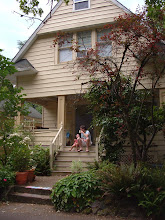
When we headed out in the evenings after work or first thing on weekend mornings that spring, we assumed classic drive-by positions: Alex behind the wheel and I riding shotgun, in charge of holding coffee cups and half-eaten jelly donuts. With the Thomas Guide open on my lap, I navigated us through the more affordable sections of Portland and kept my eyes peeled for “For sale” signs dangling from hangman-style posts. At promising houses, we pulled over and I jumped out to grab flyers from their flimsy plastic holders. On each I wrote the date and quick notes—“busy st.” “cute!” “backs up to parking lot”—then organized them in an expanding folder so we could pore over them at home like trading cards.

We knew exactly what we wanted—a pre–World War II house with at least two bedrooms, hardwood floors, original fixtures—but what we didn’t know, what we never asked each other, was why. Neither of us had lived in an early-1900 house, though we somehow had a shared longing for one. Alex grew up in a ranch house in a suburb of Denver. I grew up in a series of rentals—none of them architecturally distinctive—in Hawaii. And the house we’d owned together in Eugene—the first for both of us—was a simple ranch with wood floors and a yard that went on and on.

Where did this love of nine-foot ceilings and crown moldings came from? This need for period light fixtures and glass doorknobs, honey-colored wood floors and leaded glass windows? We wanted all of this on decent-sized lot on a quiet, treed street in a good neighborhood near parks and shops and restaurants, all for well under $200,000. And a fireplace and porch would be swell. Our realtor, Brad, stifled a yawn when we gave him the list. We were, after all, describing 90 percent of the housing stock on Portland’s inner eastside, which was steadily and efficiently developed, borough by borough, over the late 1800s and early 1900s. Bungalows and Craftsman houses line up, one after another on every street on the grid, with handfuls of Colonials, Tudors, and Victorians thrown in for good measure. Brad tried to talk us into looking at a “tricked out” ranch he’d seen up in Cully, complete with finished basement, hot tub and a wet bar, but our minds were made up. We should have felt more at home in such a house, but instead, we spent weeks looking for those telltale period details that comprised what we imagined as the perfect house.

Seattle architect Grant Hildebrand says that Americans are innately attracted to these homes built before World War II when development was small scale and craftsmanship was inexpensive. What this means is that though many of these houses look alike and have many of the same characteristics, they were, for the most part, designed and built individually, unlike the rapid-rise of suburban homes, described by singer Malvina Reynolds: “Little boxes on the hillside, little boxes made of ticky tacky, little boxes on the hillside, little boxes all the same.” Reynolds’s song critiques not only the architecture of these houses, but also the lives of the people who choose to live them, as homogenous and uninspired.

The early 1900s American bungalow has come to represent a strange combination of individuality and mass-market appeal. Diane Maddex, author of Bungalow Nation, says that bungalows allowed middle class Americans to have “an affordable paradise of their own,” and between the early 1900s and 1930s, bungalows became the most popular house style in America, exceeding the number of other types of cottages built in 125 years. She explains that the form was a kind of rejection of and response to Victorians, which were seen as ostentatious. Bungalows, on the other hand, were simple, artistic, and democratic—altogether more reflective of middle class values. She writes, “The lowly bungalow in fact became America’s first national house type. Inexpensive, simple to build, modern, and sited on a private plot of land, it was architecture for a democracy as envisioned by Frank Lloyd Wright in 1910: ‘America, more than any other nation, presents a new architectural proposition, her ideal is democracy.’”

The suburban ranch house developments that followed at mid-century were created in a similar spirit of democracy but more so in appreciating the needs of the American family to be away from the “ills” of the city in a home that came complete with a two-car garage and fenced back yard. But the bungalow and its craftsmanship, no matter how simple and inexpensive, still evokes a deeper and more respectable history to middle-class Portlanders, who, compared to their counterparts in other urban areas across the country, are more inclined to buy old houses within miles of downtown.

Knowing Portland had entered the new millennium at the peak of a booming sellers’ market, where the best of these period houses were selling within days at tens of thousands of dollars above listing prices, I asked Brad, “Are we completely crazy? Do we even have a chance?”

“Oh sure,” he said, doing his best to sound sincere. “But you’d better be ready to jump.”

We were ready. We’d been warming up for weeks. By May, we knew the neighborhoods as if we’d platted the eastside ourselves: Humboldt, Boise-Eliot, Kenton. King, Concordia, Beaumont. Richmond, Sunnyside, Buckman. We knew where to look. We knew what we wanted. But what we didn’t really know was why, not only “Why a period house?” but “Why now?” Why jump into fray when one of us was newly out of grad school and in the first years of a new job and other was working part-time and cobbling together freelance work on the side?

After all, most of the economic news in 2002 was bad: Interest rates were dropping but housing prices were creeping up. Oregon boasted the highest unemployment rate in the country as well as having some of the highest home prices. Nationally, the recent period of record home sales was the same period of record mortgage foreclosures. But there we were, caught up in the frenzied spring ritual of open houses and drive bys, ready to jump into the offers-clauses-counteroffers-exclusions-inspections-exceptions fray. On TV, Fannie Mae’s commercials reminded us that they were “in the American Dream business.” Neal Conan on Talk of the Nation discussed the rising costs of houses and asked listeners, “What are you willing to give up to afford your piece of the American Dream?” Newspapers reported that home ownership was at an all-time high—68 percent of Americans had their piece of the rock. We didn’t want another day to go by without having ours.

Wednesday, July 23, 2008

Technical difficulties

Have lots to write about but no ready access to the Internet. Here are some hints of things to come:

1. What happens when you take your kid to SF MOMA and she falls for the somewhat gruesome and hard to explain work of Frida Kahlo? (Frida tattoos, anyone?)

2. Trashy magazine report: Cookie, Domino, InStyle (the New Yorker is under a pile of dirty clothes in my suitcase)

3. Should we have/attempt to have/adopt a second child? Arguments for and against from a panel of experts and others who have no credentials but lots of opinions.

Check back soon, though probably not until Friday evening when we're back in P-town.

Friday, July 18, 2008

Love: A Pie or No?

Being in Tahoe for C & B's wedding--with all the typical ensuing craziness, frivolity, and mayhem--makes me think of both my own wedding ten years ago and Amy Bloom's short story, "Love Is Not a Pie." Though I haven't read that story in years, I still remember its vivid first line (though I cheated and looked it up online to get it exactly right): "In the middle of the eulogy at my mother's boring and heart-breaking funeral, I began to think about calling off the wedding."

The story is about a woman who comes to realize that her mother has been involved in complex relationships involving more than one man, and when she confronts her about this, her mother says something like, "Love is not a pie." I've always been intrigued by this idea that love isn't something round and finite that you divvy up into allotted slices, that it instead sprawls and meanders and is unwieldy (perhaps like a pie that isn't made with enough thickener, or more of a galette?), and the better for us, perhaps, to accept this--or, at least, the more interesting our lives might be if we do.

I thought about this line, "love is not a pie," when SB asked me for the second time "why" B & C are getting married (I think her exact question was "Why are they doing that?" as if "that" involved eating food off of a nontraditional surface). I said something like, "Because that's what people do when they love each other," but of course it's not that simple. For one thing, with rare exception, only marriages between men and women are recognized in most municipalities in this country. And certainly some people who love each other never get married, but their lives still seem pretty okay. So I gave her a short answer for a difficult question.

As for my own wedding, Alex and I had lived together for five years before literally throwing a wedding together in three weeks. It was one of those rare impulsively practical decisions: he was heading to grad school that fall and needed health insurance, we were feeling romantic one evening, and his family was going to be in town anyway. Why not get married? (Or, as SB might put it, "Why not do something like that?")

Ten years later, it seems silly, but not surprising, that I overthought something like getting married to a person I loved. Part of it was stubborn loyalty to my younger self and ideals of freedom, part of it was skepticism that marriage was such a great idea to begin with, and part of it was fear that getting married would be a public admission that I believed in something as unpredictable as love. It turns out that this last thing, admitting that you have faith in something or someone, is actually the best reason of all to get married.

I wrote about our marriage in a couple of different essays several years ago; one of them, "Plans Made Under the Stars," which was published in Notre Dame magazine, is still available online. Read it at your own risk: it seems like a painfully melodramatic piece to me now. The more interesting thing is a "letter of consternation" written by a woman who says that because of my essay, she and her husband weren't going to send their usual donation to Notre Dame. Apparently, the fact that we didn't tie the knot Catholic style and that the magazine chose to run my essay were terribly offensive to her. This is a person who clearly believes that love is simply a pie.

Tuesday, July 15, 2008

Home Away from Home

Later this week, we're heading out of town for several days--to Tahoe for a wedding and then driving over to Berkeley and S.F. to visit old friends. In Tahoe, we'll be sharing a vacation house with the friend who's getting married, her daughter (who I've known since she was an adorable, inquisitive middle schooler and who is now a beautiful, brilliant 20-something), and their friends and family. In Berkeley, we'll be taking over the living room of my BFF's new house and generally wreaking havoc on her family's daily life for the good part of a week.

In both cases, it'll be tight quarters and awkward in the way that is part and parcel of traveling and staying with loved ones. Hotel rooms, though sterile, are easily commandeered and made into some facsimile of home--on a family trip to Astoria, I remember setting up a decent mobile office in our hotel room bathroom in the middle of the night during a bout of insomnia. Same with cabins, tents, condos, and other vacation rentals that are rented solo: family swoops in with bags of stuff, drops stuff everywhere, and proceeds to figure out a system of living in a temporary dwelling. Family unfolds and fills up the space around it.

It's harder to swoop in and unfold in the borrowed spaces that belong to our others. A different thing happens here: rather than shaping a space into an image of ourselves, we assimilate, as best we can, into a home's rhythms and systems. It's an unusual kind of on-the-fly homemaking that shows up in things as small as how to hang a roll of toilet paper or whether to use a sponge or rag to wipe up spills in the kitchen, and as large as whether a family eats meat or how parents discipline their children. Traveling and staying with other people, no matter how well you know them, can be a small-scale anthropological experience--and good practice in testing the rigidity of our boundaries, expectations, and values.


But travel also reminds us that our ideas of home are portable, even though our dwellings generally are not. I remember one incident that made me realize how complex SB's (and, I'm willing to bet, most children's) understanding of home is. When she was not quite two, we rented a rustic two-room cabin in Silver Falls State Park that was really nothing more than two closets: one with a bunk bed and double bed squeezed in together and another with a counter top, fold-down table, and futon. The bathroom and shower were through the woods and up the road a bit, perhaps 100 yards away. This is a picture of SB and her dad enjoying a campfire in our "living room."

SB loved being able to roam the grounds around the cabin, digging in the dry dirt with a stick, climbing the slightly bent fir in front of the deck, collecting rocks and gravel and pine cones and putting them in a paper bag. The cabin was one of three on a cul de sac where cars sometimes wandered, lost and misguided, looking for the campground proper or another set of cabins. We had to show SB that, unlike in the city, the road wasn’t separated from the “not road” by a curb—that the two blended together and she needed to be careful. It’s funny how quickly she learned the geography of that new place. When she wandered toward the road that first afternoon and we called to her, she turned, faced us, pointed to the cabin, and said, “Home,” before moving back toward us.

Though she'd identified the cabin as "home," she really only accepted it as such because Alex and I and all of our stuff--green blanket, sheep, toys, food, clothes--were there. Home, to her, could be both a place and a set of people and things. In many ways, it's simply the relative center of the world on any given day, in any given city, which is a nice way to think of things when you're on the road.

Happy travels, everyone.

Sunday, July 13, 2008

A grown-up house

Our friends and their young sons were over for dinner the other night. It was the first time W had been to our new house and he immediately said, "Wow, this is a grown-up house!" and K nodded in agreement. While we ate, I asked them to be more specific.

K said it was something about the open stairwell, and W added that high ceilings both up and downstairs also made the house feel grown up. Admittedly, our "new" house (which is actually about 20 years older than our "old" house) is much bigger, in square footage as well as in what K described as stoutness. But I suggested that another thing made this house seem more grown up than our other one: the entry hall. Having a room reserved for entering a house seems incredibly mature and decadent.

K & W live in a little 1920s bungalow with attic stairs (rather than open stairs) and their second floor is typical for houses of this period: one large room tucked up tight under eaves and sided by kneewalls; their house is a lot like our former house, also a little 1920s bungalow. In fact, many of the people we know in Portland live in these types of bungalows because they make up the majority of the affordable housing stock on the eastside.

The American bungalow was, according to Diane Maddex in her book Bungalow Nation, conceived as a house that is "no bigger than it needs to be." Accordingly, bungalows were designed with open floor plans, including a combo dining room-living room and a front door that opened directly into the living room. Buh-bye, entry halls and ostentatious Victorian parlors. Hello, combined public spaces and direct, easy access between outside and inside. 

Though I'm on board with the elegance, simplicity, and practicality of the bungalow style, I admit that one of the main reasons I fell in love with this old drafty fixer (called a farmhouse by some, an Old Portland Craftsman by others) was because of the entry hall with its open stairwell. There is something grand and generous about the room (cluttered though it may be), especially with light spilling in from the stairwell windows. But the room is also incredibly useful as a place to unload the gear and tools we use in the outside world: jackets, shoes, umbrellas, dog leashes, hats, gloves, bags. Yes, it feels terribly grown up to have a room for just this purpose.

Of course, we welcomed friends and family into all of our former dwellings--none of which had entry halls--with the same sense of generosity; as far as I know, not a single visitor later remarked, "Wow, that was a fun evening, but it would have been better if they'd had an entry hall in which to greet us." I think it's interesting how we emotionally respond to particular spaces. I'm sure some of this is steeped in collective nostalgia--the Norman Rockwell-esque image of guests arriving for Thanksgiving dinner and being greeted by an apron-clad mom in the entry hall. But this intuitive reading of space must also be rooted in something deeper. 

Maybe Christopher Alexander is on to something when he emphasizes the importance of transitional spaces like the entry hall in his book A Pattern Language: "the time of arriving, or leaving, seems to swell with respect to the minutes which precede and follow it, and that in order to be congruent with the importance of the moment, the space too must follow suit and swell with respect to the immediate inside and the immediate outside of the building."

His description makes spaces sound alive, which perhaps they are when imbued with the energy and emotions--pleasure, enthusiasm, anticipation--that we carry with us.

Saturday, July 12, 2008

Where it begins

In response to folks who've asked, "How's the thesis coming along?" here's sneak peek at part of the intro, not-so-sneakily disguised as a blog post and supplemented with photos from the kitchen renovation mentioned in the first graf:

One summer morning in 2007, my two-and-a-half-year-old daughter padded downstairs to find the refrigerator in the dining room. The prep tables that had once served as extra kitchen counter space were now also in the tiny room, along with the cobalt blue microwave and the stainless steel rack that had once held dishes in the nook. SB didn't bat an eyelash. As she climbed into a chair at the dining room table, I explained that we were starting the kitchen remodel that day and she'd be going over to a neighbor's house for a few hours so her dad and I could tear the lathe and plaster off the walls. Still completely unfazed, she nodded her head agreeably and asked for a strawberry yogurt.

Although I later wondered what it must be like to grow up in a state of constant upheaval--piles of debris and tools spread throughout the house as common as piles of stuffed animals and Crayola markers, the gritty film of sheetrock dust on every flat surface, the sharp smell of varnish and paint in the air--at the time, it was simply another day in our family's life. Even in utero, SB must have heard Alex and I arguing about where to put the skylights, what color to paint the bedroom, or whether to use oak or bamboo flooring upstairs. Some kids wake up to high-rise views of the city or the smell of grass and cows in the country: SB spent her first three years enveloped in the sights, sounds, and smells of a house in progress.

My husband and I aren't flippers or remodelers: we both have full-time jobs in fields that have nothing to do with real estate or houses. Instead, we're middle-class homeowners who bought a small house in a hot real estate market and then spent the next several years transforming it into a wood-and-mortar version of who we are. In other words, we're a lot like the other young upwardly mobile American couples you might know or see at Home Depot early on Saturday mornings or read about in Sunset and Dwell magazines.

If we were just a generation older, we might have been called yuppies, but we're more akin to what David Brooks, in his 2000 book, dubbed "bourgeois bohemians" or "bobos": mid-twentieth century anti-establishment liberals who broke through the traditional stranglehold of Protestant elites at the country’s best schools and worked their way up various professional ladders to suddenly find themselves firmly on the upper and upper-middle class rungs of American society. Brooks says that because of this history, Bobos are “an elite that has been raised to oppose elites,” and, therefore, a conflicted lot—a socially enlightened, educated class that feels anxiety and guilt about their wealth and participation in consumer culture.

Brooks says that in response to this guilt, Bobos have devised a set of codes to both justify and regulate their participation in capitalism, “encouraging some kinds of spending, which are deemed virtuous, and discouraging others that seem vulgar or elitist.” Virtuous spending might include buying old or handmade things that show craftsmanship and have “soul,” or supporting local, small businesses over large, national chains.

Although we’re perhaps on the tail end of the Bobo generation, Alex and I and most of our peers not only have the college diplomas and white-collar paychecks, but also guilt and anxiety about consumerism. In broad, general strokes, we are a group of people who strive to be hands-on, conscientious, political citizens who buy local goods, eat seasonal produce, and make things with our hands. Of course, this runs a wide gamut: Some people don’t own cars, grow much of their own food, and buy products from within one hundred miles of their homes. Others invest in green building and remodeling supplies and drive Priuses. Others buy mostly organic produce and eggs, use low-VOC paints, and grow native plants. But regardless of the various permutations, for most of us, our homes are both our laboratories where we experiment with materials and ideas, and our canvases on which we communicate who we are and what value.

It makes a lot of sense that Bobos use houses in political ways, because doing so justifies what is, for most middle-class homeowners, a huge expenditure and also the straightest path to wealth—less risky than the stock market and more profitable than a savings account. By renovating an old house with “soul,” building a green house on an infill lot close to public transportation, or pulling up lawn to plant vegetables, we can rationalize home ownership as virtuous spending. And on a more spiritual level, a house can be a life’s work, akin to a novel or painting or symphony. It can be justified as an aesthetic endeavor that fulfills deeper, undeniable human needs.

Wednesday, July 9, 2008

Hump Day: Messy but Inspiring

This is what our coffee table looks like by Wednesday. (Actually, this is what it would look like any day of the week if one of you dropped by unannounced. If you want a cleaner house, we need at least a few hours notice.)

The entire living room looks much worse: There are a couple of days-old half-full glasses of water on each side table (at least they're on coasters). And the mantel is a temporary resting place for an unopened box of light bulbs, a sorrowful Christmas cactus, an IKEA lamp that still hasn't found a permanent place to live in our house, the receiving end of a baby monitor, a ball of multi-colored sock yarn saved from the jaws of our cat, a bright yellow 100-foot measuring tape that weighs about five pounds, and a lovely set of Chinese bud vases some dear friends gave us as a house-warming gift (this last item really does want to live on the mantel, but can't really feel at home what with the overcrowded conditions).

Think of our coffee table as a symbol of the rest of our house: messy but inspiring.

For instance, from that pile emerged a great essay from the June 30 issue of the New Yorker: "Altered State" by Andrea Lee. I'm still thinking a lot about the ideas of belonging and patriotism I wrote about in my July 5 posting (which some of you talked to me about offline--thanks for the feedback!). So perhaps I'm just ripe for Lee's thoughts about her home state of Pennsylvania--about which she writes, "I'm not sure I love it, but it's mine."--and her sense of always feeling like a foreigner. But what most struck me, aside from her amazing skill as a writer, was the deep thought she's put into her past, not simply narrating it, but contextualizing it and using it to explore how she ended up where she is today: an African American novelist who married an Italian and is now raising her family outside of Turin:

When describing another American family (oddly enough, also from Pennsylvania) that lives nearby, she writes, "[They form] a traveling homeland still magically connected to that landlocked region, where there are school friends, cousins, acres that bear their name."

When remembering how she was the only African American child at a summer camp, she describes trying to fit in: "I try hard, out of an animal sense of self-preservation, but also because I've always imagined winning the hearts of hateful people."

When pondering why one brother stayed in Philadelphia while she and her other brother live an ocean or continent away, she posits that the brother who stayed was her mother's favorite and writes, "And who can say whether being your mother's great love doesn't trigger a lifelong passion for your home, your city, your state?"

And near the end, when reminiscing about her home state with an Italian movie director, she realizes that perhaps he is "Someone who can stare, as he does, across land and sea toward a shimmering mirage of America."

Maybe it's because of the Fourth of July that I really took a shine to this piece. Or maybe it's because I've spent so much of my life feeling like an outsider. And it's hard to not to see some of James Baldwin (a hero of mine--and hers, I'm willing to bet) in Lee's work, which makes it especially compelling. But perhaps it's because there's an incredible amount of self-reflection going on right now--people exploring how they live and why, through books and lifestyle changes and blogs like this one--that it's inspiring to see it done right and well, artfully and eloquently, in an essay like this one.