Friday, August 22, 2008

Things you'd have done this week if you lived here

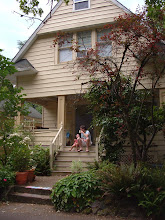
1. Jacked up your house: You notice that the front half of your house is sagging, so you tear the walls apart to find out why (no header, see "House archaeology" post), talk your wife into letting you jack the house up yourself, then, jack the house up yourself. You have to build a temporary wall to do this, and then cut the old studs so that the house will actually rise. During the week that you're raising the jacks, quarter-inch by quarter-inch, the continental plates of your house will drift back together into Pangaea: the door to your daughter's room will actually close rather than have a two-inch gap in the frame, and she'll be able to open her jammed closet door herself rather than calling you to do it for her every time she wants her dress-up clothes.

Throughout the whole process, your wife will have a semi-permanent worry furrow on her forehead and may need constant reassurance that you know what you're doing, not merely think you know what you're doing. Though you've been together a long time and have done many difficult tasks simply by reading books, getting advice from friends, and tapping into your bottomless well of confidence, you should just smile and tell her things will be okay. And when you take a day off in the middle of the week to build the new wall, and then run into a moment where the house almost falls down because the temporary wall slips and the old wall is no longer there to hold it, and you have to grab a two-by-four to prop the house up while you run out to the garage and cut more two-by-fours to hold the rest of the house up--you should skip that part when she asks you, "How'd things go today?" Just show her the finished product, accept her congratulations and thanks, and sleep the sleep of angels.

2. Get dragged all over the tricounty area in search of even more fruit: Your parents call you a fruit bat because some summer mornings you want blueberries, peaches, watermelon, and apricots with your yogurt. But by mid-August, even you are tiring of fruit. It's peach season, and your mom's got some unexplainable attraction to stone fruits, so you have to get dragged away from your art table and your back yard kiddie pool to drive hella far east or west to find farmstands and u-pick orchards. It's hot in the car and the air conditioner doesn't really reach you in the back seat, and your carseat feels too small and cramped--Will they just get you a booster seat already? Maybe one with a cup holder like your friend Z. has.

When your mom's friend calls one night and says, "The Veteran peaches are here!" you just know tomorrow is shot. And sure enough, you're on the road at 8:30 a.m. on a stay-home day. You're in the back seat with a grown-up you've just met, so now you've got to make small talk, which is fine, but it's a long drive and your mom and her friend in the front seat are talking about boring things like anti-consumerism and urban homesteading, so you talk to the nice grown up next to you about your favorite color and point out letters you know on the billboards outside.

The orchard is just another orchard--seen one, seen them all. You make your mom pull you in the wagon and then pick a few peaches that are growing at branches at your height, sneak one and let the juice dribble all over neck and t-shirt and arms. Briefly, you and your mom talk about a book you just read, James and the Giant Peach, but then she is off again, picking, picking, picking. All the grown ups are hunting for the perfect peaches, clucking at the disappointing size and color of the fruit, and talk about coming back next week. Sigh. The high point of the whole excursion is in the car when the friend gives you a tube of lipstick and urges you to put some on, and your mom's grimacing in the rearview miror, so that makes it even better as you slide some of that stuff on your lower lip and most of your chin.

Later that night, spend an hour crawling around naked on all fours meowing. When your parents ask what you're doing, say in kitty broken English, "Me Mucous the cat. Meow." Refuse to answer to your given name, so they have to call you by your kitty name in order to get you to put your jammies on and brush your teeth. You've put up with the peaches this week--the picking and the canning and the jam-making and the sorbet-making. You are Mucous the cat, and this night is yours.

3. Nursed your latest bout of insomnia with Jane Austen: While channel surfing last week, you get caught up in the 2005 version of Pride and Prejudice, particularly the Netherfield Ball scene in which the camera dips and floats through the crowd giving glimpses of 18th social hierarchies, maneuverings, and manipulations. This world of good marriages and important connections, of aristocrats and bourgeoisie figuring out how to fall in love with one another, of spirited daughters, plain daughters, imprudent daughters, and stoic daughters is as familiar and comforting as mac and cheese.

So when you're tossing in bed at 4:30 a.m., fretting over everything from problematic chapter five of your book project, to daunting deadlines at work, to all the slowly rotting fruit in the kitchen downstairs that needs something, anything, done to them, instead of your customary walking of the rooms, you dig out that old marked-up paperback from some undergraduate English class you took eons ago, curl up on the couch, and get swept up all over again by Lizzie, who is you and every woman you know, and Darcy, who is every man you know. But what you love most, what settles your mind enough so you can catch another hour or two of sleep, is how how propriety and expectations and order, as restrictive as they were to the Bennett sisters, provided at least some kind of framework, some kind of boundary, within which their lives were to be lived. Because in the middle of the night, your own world seems shapeless--the edges too far off to be useful in giving you a sense of direction or a hint of what's to come. You know the happy ending for Lizzie and Darcy, know that it all works out for everyone, so the constraints of their lives comfort you. You don't read to critique or to understand--or even to feel grateful to be a modern woman, because at 4:30 a.m., that doesn't seem like such a great thing to be at all.

Monday, August 18, 2008

A hundred little deaths

You know what makes a house feel like a home? No, silly, not a sheetrocked wall! Six quarts of home-preserved peaches, that's what.

First off, WTF? On the way home from our Sunday excursion to "the country" (a.k.a. east Portland), at the tail end of one of the hottest weekends of the year with twenty pounds of peaches and a flat of blueberries in the trunk, Alex and I pondered this very question. We've been together for fifteen years, and I don't think we've ever eaten canned peaches, so why my plan to clutter the kitchen with cauldrons of boiling water and an assembly line (consisting of SB and me) to blanch, cool, peel, cut, pit, cook, and can these summer fruits? I could just cut them up and freeze them, or, crazy thought, just enjoy them while they're in season, for breakfast with yogurt, or off the pit with lunch, or in cobblers or ice cream for dessert. But no, I wanted to preserve them.

The only reason we could come up with was that it would be funny to have canned peaches in winter that we could bust out some cold winter night when we wanted to pretend we were on Deadwood. Other hardcore fans of this most excellent show may remember how saloon/brothel owner Swearingen has one of his lackeys open a can of peaches for important meetings of the town leaders. (SB would be our lackey, of course, scampering down to the basement to receive a jar for our "family meetings.")

Not a compelling reason to spend a couple of hours in the kitchen, but yet, there we were: SB diligently slipping or scraping the fuzzy skins from the pulpy fruit while I managed the things involving heat and knives--so, everything else. When we got home today, we admired our handiwork and SB said, "Let's eat some!"

I responded, with a sharp intake of breath, "Are you kidding? Eat a fresh one. These are . . ."

"For winter," she muttered, remembering some Little House on the Prairie schlock I fed her as motivation while we were slaving away the night before.

"Right," I said, feeling a little silly. For winter? We live in a city that sees maybe two weeks of truly inclement weather--and those are broken up into a couple of days at a time, here and there. We live within ten blocks of three grocery stores, not in the middle of fricking nowhere, some place where you really have to stock up on food or else you might die of starvation. So, again, WTF?

I posed the question to my BFF on the phone this evening and she offered, "They look pretty," doing her job of supporting my whims unconditionally while not pointing out any utter contradictions or personality flaws. But this suggestion, the best effort of an incredibly smart person, was pretty thin, and we both knew it.

Yes, they do look pretty, and I do feel satisfied to see the growing collection of jars in our basement, but that's not the whole story. I also don't think my reasons are as altruistic or political as what Harriet at Preserve (where I learned to can) would say, that growing and preserving our own food is a way of breaking our dependence on both an industrial food production complex and a flawed economic system that has consumers stuck in a cycle of working too much and buying too much toward some unclear end.

This all makes a lot of sense to me, but I think another reason I've spent so much time this summer looking for, eating, and preserving seasonal produce is more emotional. Every summer that I've lived in Oregon, I've marked time through fruit, experiencing each as a mini-lifetime: anticipating the arrival of the first strawberries, then relishing them, preemptively mourning them, and, finally, fully mourning them. And so on, and so on with raspberries, peaches, blueberries, melons, figs, apples, pears--a hundred little births and deaths. Thinking about eating Hood strawberries only once a year is a little bit heartbreaking, especially when I do the math and think about how many more strawberry seasons I have ahead of me.

Sentimental and overly dramatic thoughts, for sure, and more evidence of why rudimentary math skills in the hands of a writer is a dangerous thing. Considering that I'm on the verge of turning forty, this reeks of a pre-midlife crisis, which totally fits. I am the queen of preemptive mourning. I mean, if I let myself mark time like this in other ways--number of family summers we have before SB is an adult, for example--I'd just end up curled up in fetal position in a darkened room for days. So maybe putting up these peaches is a way of stopping time or, at least, messing with it. I don't know about you, but I find that a little denial and delusions of control are helpful in getting through any given day.

Friday, August 15, 2008

Too many "people like me"

In yesterday's Oregonian, there was an article about how homogenous Portland has become. Based on Bill Bishop's book The Big Sort: Why the Clustering of Like-Minded America Is Tearing Us Apart, complete with photos of urban chickens, bike riders, and coffee shops, the article describes how the majority of Portlanders live in a bubble of liberalism that makes it hard for dissenting voices to be heard. Though more of a feature than a hard news story (only one liberal viewpoint and one conservative viewpoint are represented), the story got me thinking about how the comfort of living among like-minded people can actually lead to complacency and, as my friend T. describes it, smugness.

Alex and I talked at lunch about whether it was good to truly have diversity in your daily life, challenging moments where people don't automatically agree with what you say or how you live. I've become a lazy thinker because of living in such a blue city and if forced to defend my political and social beliefs, couldn't argue my way out of a paper bag. Those oral skills are atrophied. And though a source in the article says that people can find lots of dissenting views thanks to easy access to the internet, do I have conservative media pages bookmarked on my computer? Of course not. I can extend the bubble as far and wide as I need to.

And homogeneity can also lead to a kind of cultish mindlessness, too. Among "people like me," it manifests in the whiff of competition, and subsequent defensiveness, around anything having to do with food, child-raising, and transportation. People like me explain the genesis of our food in great detail: whether it came from a CSA or farmers' market, what farm it's from (bonus points if you talked to the farmer), and whether it's organic or local or free-range or--ka-ching!--all three. People like me either stay at home to raise our kids OR research preschools, visit open houses, agonize during the decision-making process, and then feel guilty about sending our kids to preschool. People like me go to events that include, as part of the invitation, encouragement to not drive and instructions about bus lines and bike parking. People like me can be pretty annoying. Sometimes, I hate those people. I don't want to be those people. But here in homogenous Portland, I am.

On a good day, I bite my tongue when a friend talks about making asparagus for dinner in the middle of August, let my daughter play with a Bratz paper doll at a wedding reception but later embargo it and claim that it must have gotten lost on the plane, and merely give my husband a look rather than scold him when he chooses to drive rather than ride his bike to the hardware store seven blocks away to buy lumber. I won't flatter myself and pretend that these reactions and behaviors have much to do with altruism; they stem, instead, from those old feelings of guilt and insecurity. I look around and see the chicken coops and Priuses and grain mills that litter this fair city and realize that I haven't been working hard enough to be the best enviro-green-socially conscious Portlander that I can be!

If I'm right and my motivation is, at best, equal parts concern for the future of the planet and a need to belong, this supports my theory that we never completely shake off the social experiment/trial by fire that is high school. Am I still Molly Ringwald, wanting to hang out with Andrew McCarthy and the other cool kids?

But, just like in high school, this sort of cliqueishness also triggers the rebel in me--the side that doesn't want to be one of a faceless mass of people, no matter how right (or righteous) and cool they are. My friend T. and I joked by email about our imaginary next get together: "Let’s be sure to drive wherever we’re going and eat out-of-season food and maybe let our kids play with plastic toy guns, okay?" I wrote. "Sounds like a plan," he responded. "I’ll bring some cold cuts and frozen burger patties from Safeway."

But now, we're feeling smug about not being smug Portlanders, which I mostly am. Just scratch the surface of my tough talk and petulant demeanor and you'll find a neo-hippie do-gooder who feels guilty about not composting, who's worried she's not going to be able to put up enough peaches and blueberries for winter, and who's excited about getting an Xtracycle free radical kit for her bike so she doesn't have to lug her 40-pound daughter to the library in a Burley. In Portland, it's a John Hughes film all over again and nobody wants to be freaky Ally Sheedy, sitting at the corner desk, glowering and dressed in black.

Sunday, August 10, 2008

Baby love fells another practical woman

My OB has done a complete about-face, and it freaks me out. I've always liked her because she’s direct and straightforward, but kind—unlike my primary care provider, who is direct and straightforward, but not so kind. (She’s not really unkind, but she glowers a lot; maybe that’s just her default face?) My OB tends to be overly cautious like most doctors, motivated, I’m sure by fear of lawsuits.

But she’s also unapologetically practical. When I showed up at my exam last year hemming and hawing about whether I was going to try and have another baby, she started listing all the reasons I shouldn’t. I’d had some minor complications when I was pregnant with SB, so she rightly mentioned that. Then she started listing off all these others reasons I shouldn’t have another child, primarily because I’d be having a “geriatric pregnancy." (I talked to a friend about this the other day, explaining that I felt like I was in that scene from Knocked Up when the pregnant main character and her sister are trying to get into a club and bouncer tells the sister, “I can’t let you in because you’re old. Not for this earth, but for this club.”)

My OB was very specific in describing how my “advanced maternal age” would put me at increased risk of having twins (an aging woman’s body begins freaking out and spitting out multiple eggs during ovulation) and also of having a baby with birth defects. And two kids aren’t twice as much work, said this woman who didn’t have children of her own, they were, like, three times as much work. And don’t forget gestational diabetes! At one point, she smiled, looked at me with her incredibly kind eyes, and said, “Just get a dog.”

While this exchange would enrage some women, I found it hilarious and refreshing—I prefer when people just lay their opinions out on the line. And I knew that no matter what I chose to do, she’d take excellent care of me. Plus, I don’t know why it’s assumed that OBs are pronatalists; as a magazine editor, I’m pro-magazines, but I don’t think everyone should publish one.

But this year, when I called in April to schedule my annual exam, I was told that my OB was on maternity leave. Uh. Huh. Did I want to schedule with another doctor in the practice? Oh, no, I said. I’ll schedule something for when she’s back in July. Secretly, I imagined sparing her the teasing she so deserved, but smirking just a little when she walked in looking sheepish. I giggled with anticipation.

But when my appointment came last week and she walked into the exam room, she had that classic sleep-deprived look of a new mother and I felt immediately protective of her—big, strong me in my shorty paper robe and drape. I congratulated her and asked how she and her daughter was doing. She gushed about how great her pregnancy was and the delivery, too, and the baby was amazing—a gem—even though she cried for the first three months straight. At one point she said, “It's hard to be away from her. I have a newfound respect for mothers.” This is what a former colleague of mine would call a “come to Jesus.”

She admitted that, as an OB, she was an anxious pregnant woman, convinced that something would go wrong, but nothing did. “It’s amazing,” she said, “that of all the things that could go wrong, most times, nothing does.” It occurred to me to mention that this shouldn’t be amazing because statistically, in the modern industrialized world, pregnancy and childbirth aren't high risks for most of the population.

But a doctor friend, who happens to be a patient of the same OB, explained to me that doctors see a lot of bad things, and, for that reason, it’s hard to shake the sense that something could go wrong at any moment. It’s not the same thing at all, but this is why I no longer watch the TV news or shows set in hospitals. Especially this week, when there have been two tragic accidents—a helicopter crash that killed nine people, including eight firefighters, and a plane that flew into a vacation home on the coast killing not only the two men on board, but also three children who were asleep in the house—an unaffected life feels like a huge blessing when, really, it's the norm.

Though my OB is newly pro-baby and pro-mama, she’s still as practical as ever, telling me that if Alex and I decide to try and conceive but aren't successful within three months, I should look at other options. She explained that my aforementioned complications would make her leery of prescribing the usual hormone-laden drugs. When I suggested acupuncture (I don't make a habit of telling my allopathic care providers about my cadre of alternative care providers because it feels a little like I'm being disloyal), she said, "Good idea. I don't know why it works, but it does." And though she still listed the risks, she didn’t tell me to get a dog. That firsthand mama-love is a powerful thing: it can make a skeptic a believer and a practical person of “advanced age” roll her eyes at statistics.

Thursday, August 7, 2008

What to do with the past?

Alex completely busted me having yet another sentimental moment the other day. It was when we were prying the lath off the studs in the kitchen. I commented that what we were doing was sort of sad because someone more than a hundred years ago had put this house together, nail by nail, strip by strip, and here we were, tearing it all apart in mere hours.

Over lunch today, he said my remark surprised him because, of the two of us, I've always been less concerned about preserving the traditional characteristics of our houses. While Alex digs through piles of old molding in the bowels of Hippo Hardware, I peruse Dwell magazine to figure out how to make our traditional house more modern. In both of the older homes that we've owned and remodeled, I've rallied to open up our floor plans and use modern materials and designs in our updates. But it doesn't mean I don't recognize the symbols of the past as important, too.

As part of my job, I attended a meeting on Wednesday, with about fifty of the state's heritage, history, and preservation folks, to brainstorm ideas for a conference next year. At one point, one gentleman raised the issue of how sustainability, for which Portland is famous, and preservation could work together. He commented that sustainability efforts in urban planning tended to involve tearing down older, historic homes and putting up higher-density new dwellings. It was an interesting observation: how do we move forward to address the way we live now (Drywall and bamboo floors) but also protect and preserve the creations of our past (lathe and hardwoods)?

Is this a line that anyone can really walk? Though many folks I know work hard to preserve or restore the original details of their homes, no one is putting up whole walls of lath instead of sheetrock. Companies like Rejuvenation Hardware and Pottery Barn seem to do this, creating and selling products that nod to the past. And New Urbanist architects and planners develop mixed-use commercial/residential neighborhoods and traditional-looking houses with porches in an effort to recreate an idealized lifestyle--one that my planner husband is quick to point out is no longer a reality. Cities are too big, many Americans can't afford to live close to where they work, communities are built less around neighborhoods and more around common lifestyles and shared interests. So perhaps these gestures to the past are at best nostalgic and at worst marketing.

As we pull our house apart at the seams and find treasures of the past hidden in its walls, I am reminded again of the basic purpose of a house: to shelter a family, no matter when or how they live there. That's continuity--it links our past and our future no matter the materials and politics involved.

Monday, August 4, 2008

House archaeology, anthropology, and projected fortitude

Three finding about the our current remodeling project:

1. Why, yes, that IS NOT a header but a 2 x 4 holding up the entire front half of our house. And, yes, you're again right that one of the "posts" is in fact a couple of scrap pieces of wood spliced together. I thought this must have been a recent patch job gone awry, but Alex assures me that we're looking at original work. Goes to show that sometimes the much-lauded craftsmanship of the olden days wasn't all that different from today's quick-fix "make it work" jobs.


2. A list of cool and gross stuff found behind the walls so far: a doll's comb (circa 1999), a tarnished key to a lock box dangling on a chain, a mouse's nest, a desicated mouse (not found in the nest but, unfortunately, under one of the kitchen base cabinet--eww), and, most cool, a photo of a family sitting in front of the fireplace of this house. Judging from the hairstyles, clothing, and style of photo, and in consultation with our neighbors, we think the photo is dated from perhaps the 1950s.

The most interesting thing about the photo is that the family is Asian. As a multiracial person of Asian descent who's come to accept that fact that I live in a predominantly white city with an unfriendly history of race relations, there's something thrilling about living in a home once occupied by a family of color.

This is a bit of a tangent, but there was an interesting post at Racialious a couple of days ago that explored why humor based on racial stereotypes by a comedian of color, such as Indian Canadian Russell Peters, is acceptable to people of color. To help figure this out, the writer describes Junot Diaz's theory called the wheel of tyranny, in which writers of color set up worlds in which only two races are represented, white and nonwhite, with the latter revolving around and responding to the former. This wheel excludes interactions among communities of color, which can be powerful nexuses of home-making, so the Racialious writer suggests that Peters thwarts that dynamic, creates a common ground, and is thus refreshing and acceptable.

It's kind of a shaky argument, but I have to admit that something about this rings true in my response to the photo of the Asian family. Because the majority of my daily experiences involves interacting with white folks, the possibility that people of color owned this house makes me feel more at home here--sentimental, but entirely characteristic of me, despite my public bravado and default posture of skepticism.

3. Check out how spacious the dining room and kitchen look (use your imagination and ignore the studs and dangling electrical)! Question: How long can we live in this state of unrest? Answer: A surprisingly long time. I'm sure it will get old fast, but the truth is, we both work full time so this stuff gets done when it gets done. And we're still waiting on the engineer, so this rustic cabin look could be our milieu for weeks to come. Question #2: Which will come first, the completion of the project or my disinterest in writing about it? Place your bets, people.

Saturday, August 2, 2008

That wall's dead. Wrapped in plastic.

(Any Twin Peaks fans out there? If not, just disregard the title of this posting and move on to the next paragraph. Thank you.)

That's how it goes: one day, you're just an innocent, well-meaning wall, doing your part in holding up a house, providing a buffer between the working-class kitchen and the showy dining room, and the next, WHAM! You're out of there, stripped and left down to your bones. Goes to show, you've absolutely got to live each day as if it was your last, because, especially if you're a wall in our house, it might be. (Yep, this is the same wall that I posted earlier this week, only, naked.)

Alex scheduled an enormous Dumpster for delivery on Friday morning and was ch-ch-chomping at the bit to get started, but we had dear friends in town on Thursday night so we spent a fun evening out with them and our families hung out together on Friday (puzzles and pretend picnic for the kids, chortling and guffawing for the adults, followed by lunch at Clyde Common for all). And the minute we got home, I took SB up for quiet time and Alex got to work. Poor SB came downstairs, yet again (see the posting "Where It Begins") to life in a hazmat zone: the entire house tarped off and all the floors papered to isolate kitchen, dining room, part of the living room, and entry hall. Any comparisons here to a surgical procedure would be accurate.

We're still waiting for the engineer to approve our plans and size a couple of beams (the walls in question are load bearing), but we started demo to see what we had ahead of us. We pulled most of the lath and plaster off the kitchen side last night after SB went to bed--really disgusting, dirty, but yet satisfying work. Nothing makes you respect the craftsmanship of an old house like tearing it apart, bit by bit.

I was on kid-duty for most of today while Alex spent the morning removing ducts and beginning to pull apart the ceiling in the dining room while SB and I were at swim lessons, garage sales, and the library. He took a little "break" at midday to run a leg in the Rockin Relay marathon relay, then joined SB and I for Ten Tiny Dances, part of Linda K. Johnson's innovative artist in residence project down in the South Waterfront in Portland, before coming home to straighten up a bit and prepare for another day of demo tomorrow. Yes, Alex gives that other renaissance man DaVinci a run for the money.

Me? I'll keep taping floors and taking the kid to swimming lessons and schlepping buckets of plaster out to the Dumpster and arranging our social calendar. And, of course, I'll write about all of it. It's like that old saying, "Those who can, do. Those who can't, blog."